
Passive House Contractor NJ: Start Here
BlackBirdz LLC is a licensed and insured residential general contractor in New Jersey specializing in high-performance and passive house design-build projects. We serve homeowners across Northern New Jersey, including Morris, Sussex, Essex, Passaic, and Bergen counties, handling everything from passive home additions to full new construction.
A passive house is an extremely energy efficient building that uses superinsulation, airtight construction, and balanced ventilation to stay comfortable year-round with minimal heating and cooling energy. For New Jersey homeowners, this translates to measurable benefits:
- Passive houses can reduce heating and cooling needs by up to 90%
- Stable indoor temperatures in every room, every season
- Exceptional indoor air quality through continuous filtered ventilation
- Resilient performance during power outages; the house stays comfortable longer
Ready to explore passive house options? Contact BlackBirdz LLC for a free consultation on remodels, additions, or new construction.
What Is a Passive House and Why It Fits New Jersey
A passive house follows performance standards set by PHI and PHIUS (Passive House Institute US). It is not about picking “green” materials; it is about how those materials perform together as a building envelope, achieving specific targets for energy use, airtightness, and comfort.
A passive house contractor working in NJ should understand the state’s humid summers and freezing winters. Northern NJ sits in IECC Climate Zone 5A, where design-day temperatures can drop below 0°F in winter. Passive house design addresses both extremes through high R-value insulation, low U-value windows, and mechanical ventilation with heat recovery. The result: passive house buildings can reduce energy costs by up to 90% compared to older housing stock.
Compared to a standard code-built home, a passive house delivers:
- Up to 90% lower space conditioning energy use
- No drafts or cold spots; airtight construction also enhances soundproofing
- Filtered fresh air via continuous ventilation, reducing allergens and mold risk
- Greater resilience in nor’easters or summer blackouts
Core Principles of Passive House Design
Whether pursuing full passive house certification or a passive-inspired remodel, five building-science principles drive performance:
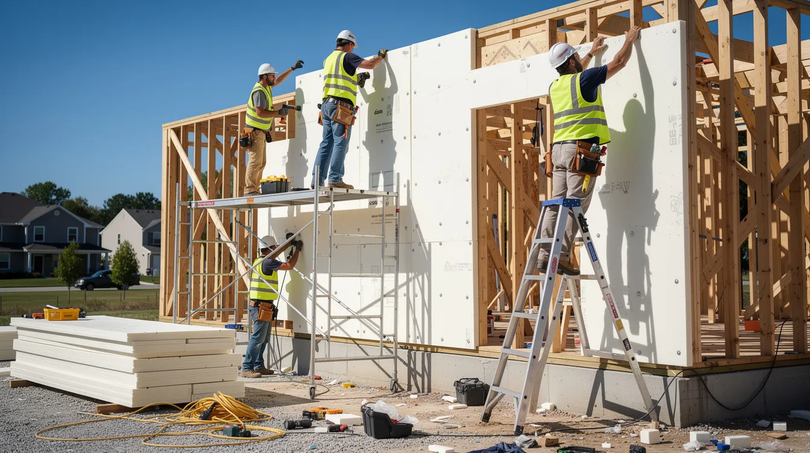
Continuous insulation wraps the entire building envelope without gaps. NJ passive house walls target R-40 to R-50; roof assemblies target R-50 or higher. Continuous insulation is essential for maintaining indoor temperatures across seasons. Code-minimum walls in Zone 5A require only R-30.
Airtight construction must achieve ≤ 0.6 ACH50 via blower door testing. Passive house certification requires passing this airtightness test. Every penetration, from plumbing to electrical, gets sealed with a continuous air barrier. Qualified contractors must demonstrate proficiency in continuous air barriers and blower-door testing.
High performance windows and doors use triple-pane glazing, low-e coatings, and thermally broken frames. Careful installation prevents thermal bridges at each window opening.
Balanced ventilation through an HRV or ERV unit delivers filtered fresh air while recovering heat in winter and, in many NJ conditions, managing moisture in summer. This is how passive houses create healthy indoor air quality without opening windows.
Thermal bridge minimization addresses cold spots at rim joists, floor connections, steel beam pockets, and balcony junctions. Experience with thermal bridge mitigation is critical. Certified Passive House Builders must have specific training in thermal-bridge-free detailing and airtightness layers. Passive house construction demands rigorous training in these systems.
Building a Passive Home or Passive-Level Remodel with BlackBirdz LLC
With BlackBirdz LLC, access design-build services from certified passive house contractors in NJ with a focus on energy efficiency. Many NJ homeowners apply passive house strategies to kitchen remodels, basement finishing, or sustainable home additions rather than building new.
A design team for a passive house project may include builders, designers, consultants, and energy modelers. Passive house projects require collaboration between builders and specialized consultants or architects. Certification requires detailed energy modeling and third-party verification, and independent verification of construction quality by energy raters is common.
A good contract should include provisions for multiple blower-door tests during construction, not just a final test. Hiring an inexperienced contractor for a passive house can lead to costly rework and failed airtightness results. Finding a qualified passive house contractor requires checking specialized professional databases. Locating qualified professionals can involve directories from organizations like Phius and the Passive House Network. State registration as a home improvement contractor is also important for verifying credentials in New Jersey. The New Jersey Clean Energy Program and local utilities may offer resources for identifying qualified builders.
Costs, Incentives, and Long-Term Benefits in New Jersey
Passive house construction increases costs by 5-10% over standard code builds for single-family homes. Larger passive house projects see a 2-3% cost increase as envelope materials scale more efficiently. Passive houses can reduce energy costs by up to 90%, which shortens payback periods to roughly 5-7 years when combined with available incentives.
Key financial incentives for NJ homeowners interested in passive house:
- Federal tax credits can provide up to $5,000 for certified homes under the 45L credit
- IRA Section 25C credits cover insulation, air sealing, and high performance windows
- New Jersey offers rebates for high-performance passive house builds, including up to $2.50 per square foot for PHIUS-certified projects through the New Construction Program
Non-financial benefits matter for daily life and long-term value:
- Quiet interiors from airtight construction and triple-pane windows
- Filtered fresh air in every room, reducing health risks from allergens
- Lower maintenance on smaller, right-sized mechanical systems
- Enhanced resale appeal as buyers research energy efficient homes
BlackBirdz LLC helps clients prioritize upgrades, whether that means high performance windows, roof insulation, or a full energy efficient home build, to get the best performance per dollar within their budget. Contact us to schedule a free in-home consultation and discuss which passive house strategies fit your desires, your project scope, and your budget.